No products in the cart.


Living the Best Life – Outside of Ordinary
From Northern BC to Mt. Kilimanjaro, discover my journey of resilience, battling illness, and supporting the ostomy community.
Support for life after ostomy – by an ostomate, for ostomates.
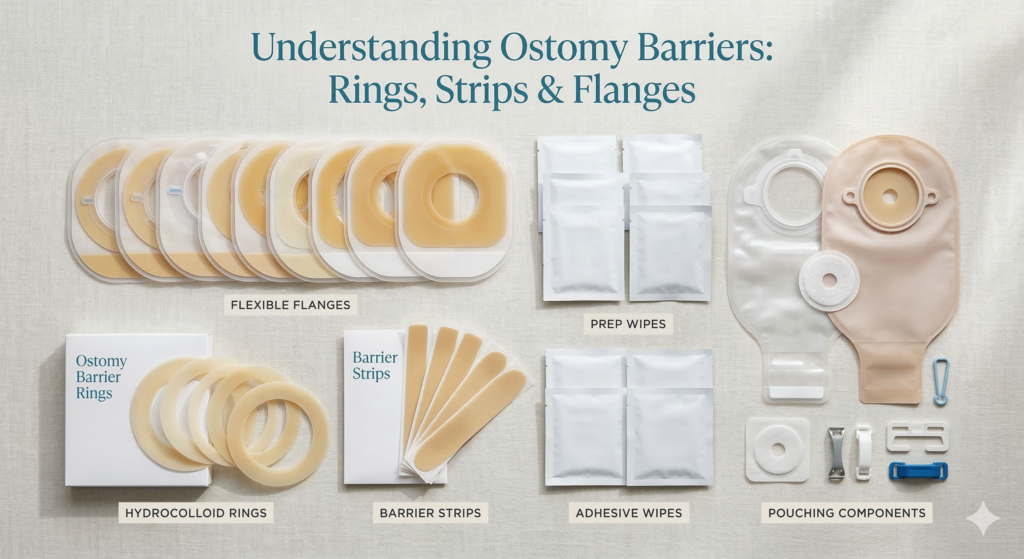
The word “barrier” gets used a lot in ostomy care, and that can make product shopping feel more confusing than it needs to be. Some people are searching for an ostomy flange. Others are looking for barrier rings or barrier strips. Sometimes they mean the adhesive part of the pouching system. Other times they are talking about support products that help improve the seal.
That is why this topic matters. It is not just about definitions. It is about helping people understand what each product actually does in real life. A barrier ring can help improve the seal and adapt to uneven skin. Barrier strips can help keep the edges of the system from lifting. A flange, sometimes called a skin barrier or wafer, is the adhesive part of the pouching system that protects the skin and helps hold everything in place.
If you have ever felt lost trying to compare these products, you are not alone. The goal of this guide is to make the language clearer, explain when each option may be useful, and help you shop with more confidence.
If you want to browse products while you read, our Ostomy accessories, Wound and skin care, and Pouches pages are a good place to start.
At the most basic level, an ostomy barrier is there to do two important jobs: protect the skin around the stoma and help the pouching system stay securely in place.
When people search for ostomy flange, they are usually trying to solve a real-life problem. Maybe they are dealing with leaks. Maybe the skin around the stoma feels sore. Maybe they are trying to understand which part of the system actually sticks to the body. In most cases, they are not really looking for a definition. They are looking for a setup that feels more comfortable, more secure, and less stressful.
That is the practical purpose of the barrier part of the system. It creates the main seal between your skin and your ostomy appliance. If that seal is working well, daily life usually feels much more predictable.
Barrier rings are extra support products that sit around the stoma to help improve the seal between the skin and the barrier. They are often used when the skin around the stoma is uneven, when there are dips or creases, or when someone wants more protection against leaks.
A good way to think about a barrier ring is as a flexible sealing layer. It can help fill in small gaps and make the area around the stoma more even so the main barrier can sit more securely.
Barrier rings are often helpful when:
You have uneven skin around the stoma
You notice leaks starting close to the stoma opening
Your abdomen has dips, creases, scars, or folds
You want a little more confidence in your seal
Not everyone needs a barrier ring, but for some people it becomes one of the most useful parts of their routine.
Barrier strips are different from barrier rings. Instead of sitting right around the stoma opening, barrier strips usually go around the outside edge of the barrier to help keep it in place.
Their main job is to support the edges of the pouching system, especially if they tend to lift with sweat, water, movement, or body contours. They can be especially useful for active people, people living in hot climates, or anyone who notices edge lifting before the barrier should normally need changing.
Barrier strips may help when:
The edges of your barrier start to peel
You are more active and want extra support
You swim, sweat, or shower often
You want more confidence during longer wear time
Barrier strips are not the same as barrier rings. Rings usually help closer to the stoma itself. Strips usually help support the outside edges of the seal.
This is where a lot of the terminology gets confusing.
A flange, skin barrier, or wafer usually refers to the adhesive part of the pouching system that sticks to the skin. In a one-piece system, it is built into the pouch. In a two-piece system, it is the part that stays on the body and connects to the pouch.
So when someone says “ostomy flange,” they are usually talking about the main adhesive barrier that protects the skin and anchors the appliance in place.
This matters because the flange is not just another accessory. It is the core part of the pouching system. Barrier rings and strips can help support it, but they do not replace it.
If you are trying to make your system easier to repeat and more comfortable, it can also help to review our Wound and skin care collection for skin-support products that work alongside your barrier setup.
The easiest way to choose the right product is to start with the problem you are trying to solve.
If the main issue is that the seal near the stoma is not holding well, a barrier ring may help.
If the main issue is that the outside edges of the barrier lift too easily, barrier strips may help.
If the main issue is that the pouching system itself is not the right fit, then the answer may be a different flange, skin barrier shape, or pouching system altogether.
A simple way to think about it is this:
Use a flange or skin barrier as the main adhesive base of the system.
Use a barrier ring when you need help around the stoma opening.
Use barrier strips when you need help around the outer edges.
It also helps to change one thing at a time. If you switch the pouch, barrier, ring, and strips all at once, it becomes hard to know what actually made the difference. A slower approach usually gives you much clearer answers.
Sometimes the issue is not just needing one more accessory. Sometimes it is a sign that the whole barrier setup needs another look.
A few clues that your current setup may need adjusting include:
Leaks happen often or in the same area
The skin around the stoma stays irritated
The barrier lifts before it should
You are needing more and more products just to get through normal wear time
The system feels unpredictable even when you are careful
If those problems keep happening, it may be worth reviewing your pouching system, skin barrier type, and support products rather than just adding more accessories. For some people, the solution is a ring. For others, it is strips. And for others, it is a different flange altogether.
This is one of the most common questions, and the honest answer is that it depends on where the leak is starting.
If the leak starts close to the stoma, a barrier ring may help.
If the leak seems related to outer edge lifting, barrier strips may help.
If the leak keeps happening no matter what accessories you add, the ostomy flange or skin barrier itself may not be the right fit for your body.
That is why identifying the pattern matters so much. The product that helps most is usually the one that matches the actual problem, not just the one that sounds most popular.
Ostomy accessories
Wound and skin care
Pouches
Ostomy Canada accessories guide
UOAA living with an ostomy
What is an ostomy flange?
An ostomy flange is the adhesive part of the pouching system that sticks to the skin, protects the area around the stoma, and helps hold the pouch in place. It is also often called a skin barrier or wafer.
What do barrier rings do?
Barrier rings help improve the seal around the stoma. They can help fill uneven areas, adapt to dips or creases, and give the main barrier a better surface to seal against.
Are barrier strips the same as barrier rings?
No. Barrier rings usually go around the stoma opening to help improve the seal there. Barrier strips usually go around the outside edge of the barrier to help prevent lifting.
Which product helps with leaks?
It depends on where the leak is starting. If it starts near the stoma, a barrier ring may help. If it starts at the outside edges, barrier strips may help. If leaks keep happening, the ostomy flange or barrier itself may need to be changed.
Understanding barrier rings, strips, and flanges makes shopping much less confusing. Once you know which product supports which part of the system, it becomes easier to solve the right problem instead of guessing.
If you are looking for products that can help create a more secure and comfortable fit, explore our barrier-support products and ostomy accessories and our pouches to build a setup that feels easier to trust day to day.
From Northern BC to Mt. Kilimanjaro, discover my journey of resilience, battling illness, and supporting the ostomy community.

How Laser Hair Removal Therapy got me back to normal.
How Support Belts are a needed component to get back to everyday living.
Discover how pre-packed ostomy change kits can revolutionize your life, offering freedom, confidence, and peace of mind for every adventure. Always be prepared.
Ostomy Athletics was built to share practical guidance, honest support, and products shaped by real ostomy experience. Learn why people trust Ostomy Athletics and how this work is helping others feel more confident moving forward.