No products in the cart.


Living the Best Life – Outside of Ordinary
From Northern BC to Mt. Kilimanjaro, discover my journey of resilience, battling illness, and supporting the ostomy community.
Support for life after ostomy – by an ostomate, for ostomates.
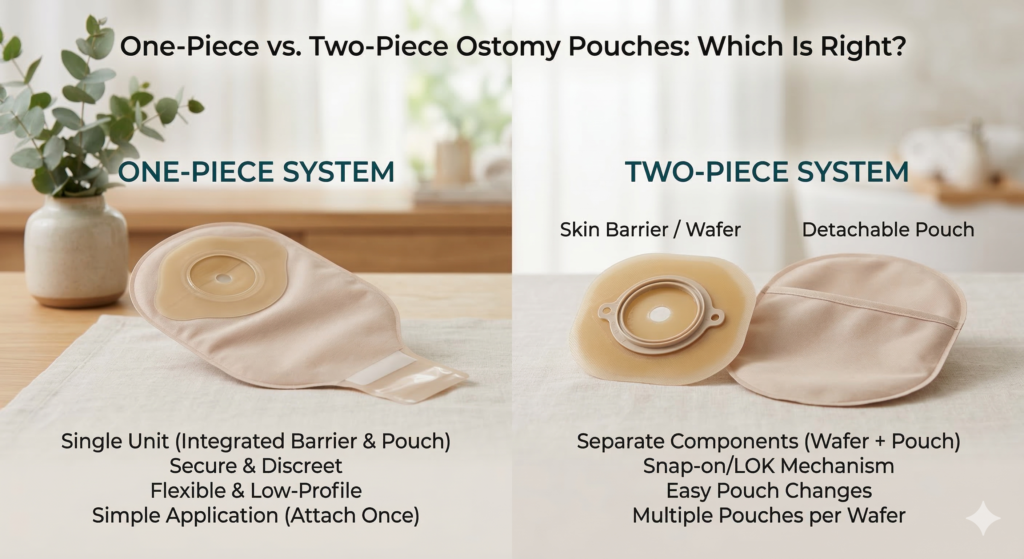
Choosing between a one-piece and two-piece ostomy pouch can feel surprisingly personal. Some people want the lowest-profile system possible. Others want the flexibility of changing the pouch without removing the skin barrier. Neither option is automatically better for everyone, and that is why this choice can feel more confusing than it first seems.
The good news is that you do not need to become an expert in ostomy products to make a good decision. What matters most is understanding how each system works in everyday life and thinking about what feels easiest for your body, your routine, and your confidence level.
This guide breaks down the difference between one-piece and two-piece systems in simple language, then walks through what to think about before you order. The goal is to make shopping feel easier, not more technical.
If you want to browse while you read, our Pouches, One-piece pouches, and Resources pages are a good place to start.
A one-piece ostomy pouch combines the pouch and the skin barrier into one single unit. That means the part that sticks to your skin and the bag that collects output are attached together.
In practical terms, when you change a one-piece system, you remove and replace the whole thing at once.
Some people like one-piece systems because they feel simpler. There are fewer separate parts to manage, and the system can feel lower profile under clothing. For people who want a routine that feels straightforward and easy to repeat, a one-piece ostomy pouch can be a very good fit.
A one-piece system may appeal to you if you prefer:
A simpler setup
Fewer separate parts
A lower-profile feel
A routine where everything is changed together
A two-piece ostomy pouch has two separate parts: the skin barrier that sticks to your body and the pouch that attaches to that barrier.
This means the barrier and pouch can often be managed separately. In many two-piece systems, you can remove or replace the pouch without removing the skin barrier every time, depending on the type of system you use.
Some people prefer this because it gives them more flexibility. It can also feel more convenient if they want to change the pouch more often than the barrier, or if they like having the option to swap pouches without fully restarting the whole routine.
A two-piece system may appeal to you if you prefer:
More flexibility
The option to manage the pouch separately from the barrier
A routine where the skin barrier may stay in place longer than the pouch
More control over how the system is changed
The main difference is simple:
With a one-piece system, the pouch and barrier come off together.
With a two-piece system, the pouch and barrier are separate.
That difference affects daily life more than people often expect. It changes how you think about changing the appliance, how you manage the routine, and what feels easiest when you are tired, rushed, or not feeling your best.
For some people, the simplicity of changing everything at once feels easier. For others, the flexibility of a two-piece system feels more practical. Neither preference is wrong. They are just different ways of building a routine.
One-piece systems are often chosen because they feel streamlined. There are fewer steps, fewer separate parts, and less to line up or attach. For some people, that makes the routine feel calmer and easier to repeat.
Another benefit is profile. A one-piece ostomy pouch may feel flatter or less bulky under clothing, depending on the brand and system. That can matter a lot for people who care about discretion or want their pouching system to feel as unobtrusive as possible.
A one-piece system may be especially appealing if you:
Want a lower-profile feel
Prefer a simpler routine
Do not want to manage separate pouch and barrier pieces
Like the idea of removing and replacing the full system together
For many people, the biggest strength of a one-piece system is predictability. The routine is clear, and that simplicity can reduce stress.
Two-piece systems are often chosen because they offer flexibility. Some people like being able to change the pouch without removing the skin barrier, especially if their skin is sensitive or if they are trying to reduce how often the adhesive part is removed.
That flexibility can also make it easier for some people to adjust their routine over time. For example, someone may prefer to keep the barrier in place while changing only the pouch as needed.
A two-piece system may be especially appealing if you:
Want more flexibility in your routine
Like the option of managing the pouch separately
Have sensitive skin and want to reduce full barrier changes
Prefer more control over how different parts of the system are handled
For many people, the biggest strength of a two-piece system is versatility.
If you are exploring options, our One-piece pouches page is a good place to compare styles and get a feel for what may suit you best.
The best pouching system is usually the one that fits your body and daily life most naturally. Before you choose, it helps to think through a few practical questions.
Ask yourself:
Do I want the simplest possible routine?
Do I prefer a lower-profile feel under clothing?
Would I like the flexibility of changing the pouch separately from the barrier?
Is my skin sensitive to frequent adhesive removal?
Do I want fewer separate parts, or more control?
Does dexterity matter for me when attaching or removing components?
How often do I want to change the pouch compared with the barrier?
These questions matter much more than trying to pick whichever system sounds more advanced. The goal is not to choose the “best” pouch in theory. It is to choose the one that feels most manageable in real life.
There is no single answer for every beginner, but many people find one-piece systems easier at first because the routine feels more straightforward. There are fewer parts to learn, and the process can feel simpler when everything is changed together.
At the same time, some beginners prefer two-piece systems because they like the flexibility and want to learn a setup that allows more adjustment later.
The best beginner system is usually the one that feels easiest to understand, easiest to repeat, and least stressful for your body. If you were shown a particular system after surgery and it is working reasonably well, that is often a good place to start before experimenting too much.
In many cases, one-piece systems are often described as lower profile because there is no separate coupling between the barrier and the pouch. That can help the system feel a little flatter under clothing.
That said, profile is not the only thing that matters. A pouch that feels flatter but causes more stress or discomfort is not automatically the better choice. For some people, a two-piece system may still feel more comfortable overall because of how it fits into their routine.
If discretion matters to you, it is worth looking at both profile and practicality. Comfort, fit, and confidence usually matter just as much as appearance.
Yes, many people do. A pouching system is not always a forever decision. Bodies change, routines change, and what felt right in the early stages after surgery may not be what feels easiest a year later.
Some people start with one-piece systems and later switch to two-piece systems for more flexibility. Others do the reverse because they decide they want a simpler or lower-profile option.
The important thing is to make changes thoughtfully. It usually helps to change one variable at a time and give yourself enough time to tell whether the new setup is actually helping.
Buying an ostomy pouch online gets much easier when you know what already works for you. The safest starting point is usually the exact product number of your current pouch or barrier. That helps reduce confusion, especially when product names sound similar across brands or systems.
If you are considering a switch, it usually helps to keep things simple. Change one part of the routine at a time rather than replacing everything at once. That makes it much easier to tell what is improving comfort, fit, or confidence.
A few practical tips for buying online include:
Keep a record of your exact product numbers
Reorder before you are almost out
Double-check whether the pouch is one-piece or two-piece
Confirm compatibility if you use a two-piece system
Save a list of the products that already work well for you
If you are shopping online in Canada, our Pouches, One-piece pouches, and Resources pages can help you compare options more confidently.
Pouches
One-piece pouches
Resources
UOAA living with an ostomy
Ostomy Canada accessories guide
What is the difference between one-piece and two-piece ostomy pouches?
A one-piece ostomy pouch combines the pouch and skin barrier in one unit, while a two-piece system keeps them separate. That means a two-piece system may allow you to manage the pouch and barrier separately, depending on the type you use.
Which pouch is easier for beginners?
Many beginners find one-piece systems easier because they feel simpler and involve fewer separate parts. But some people prefer two-piece systems because they like the extra flexibility. The best beginner system is the one that feels easiest for you to understand and repeat.
Which pouch is lower profile?
In many cases, a one-piece system may feel lower profile because it does not have a separate connection point between the pouch and barrier. But comfort and routine matter just as much as profile.
Can you switch systems later?
Yes. Many people try different systems over time as their body, routine, and preferences change. It is often best to make changes gradually so you can tell what is actually helping.
Choosing between a one-piece and two-piece ostomy pouch is not really about picking the one that sounds best on paper. It is about choosing the one that fits your body, your schedule, your comfort level, and the kind of routine you can actually live with.
If you are ready to compare options, explore our pouch collection and one-piece pouch options to build a setup that feels easier to trust day to day.
From Northern BC to Mt. Kilimanjaro, discover my journey of resilience, battling illness, and supporting the ostomy community.

How Laser Hair Removal Therapy got me back to normal.
How Support Belts are a needed component to get back to everyday living.
Discover how pre-packed ostomy change kits can revolutionize your life, offering freedom, confidence, and peace of mind for every adventure. Always be prepared.
Ostomy Athletics was built to share practical guidance, honest support, and products shaped by real ostomy experience. Learn why people trust Ostomy Athletics and how this work is helping others feel more confident moving forward.