No products in the cart.


Living the Best Life – Outside of Ordinary
From Northern BC to Mt. Kilimanjaro, discover my journey of resilience, battling illness, and supporting the ostomy community.
Support for life after ostomy – by an ostomate, for ostomates.
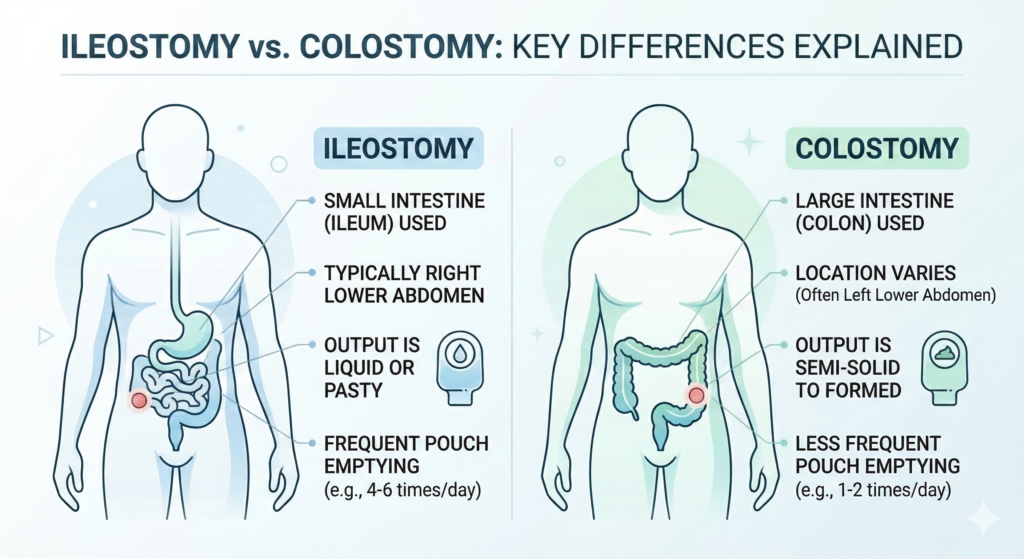
If you are trying to understand the difference between an ileostomy and a colostomy, you are asking one of the most common questions new ostomates and caregivers have. The terms sound similar, but they describe different types of ostomies, different parts of the bowel, and often different day-to-day routines.
At a high level, an ileostomy is created from the small intestine, while a colostomy is created from the large intestine. That difference often affects output consistency, hydration considerations, and how often someone empties or changes their pouching system. Ostomy Canada and UOAA both describe ileostomy output as typically looser or more liquid, while colostomy output is often softer or more formed depending on where the stoma is located in the colon.
This guide keeps things simple and practical. The goal is not to turn this into a medical textbook. It is to help you understand the differences that most people actually care about when they search ileostomy vs colostomy, so conversations with your nurse or surgeon feel less overwhelming.
If you want to browse products while you read, our Pouches, Wound and skin care, and Resources pages are a good place to start.
An ileostomy is created from the small intestine, specifically the ileum. In an ileostomy, the end of the small intestine is brought through the abdomen to create a stoma, allowing stool to leave the body without passing through the colon. Ostomy Canada’s ileostomy guide describes it this way and notes that a pouching system is then used to collect stool and gas.
In everyday life, that usually means output is more liquid or paste-like and tends to be more frequent. Because the colon is bypassed, the body has less opportunity to absorb water, which is one reason hydration becomes such an important topic for many people with an ileostomy. Ostomy Canada and Hollister both note that dehydration can be more of a concern with ileostomies, especially with high-output situations.
A colostomy is created from the large intestine, or colon. In a colostomy, part of the colon is brought through the abdomen to create a stoma. Because the colon is still involved to a greater extent than it is with an ileostomy, the output is often thicker, softer, or more formed, depending on the exact location of the stoma in the colon. UOAA’s ostomy guidance and Ostomy Canada’s colostomy resources both reflect this general difference.
That is why many people with a colostomy find that their routine can look different from someone with an ileostomy. Output may be less frequent, less liquid, and sometimes more predictable, though it still varies from person to person.
The most noticeable day-to-day difference between an ileostomy and a colostomy is usually the output.
With an ileostomy, output is often looser, more liquid, or paste-like. With a colostomy, output is often softer or more formed. UOAA’s ostomy language guide says ileostomies usually drain thick or watery liquid stool, while colostomies usually drain stool that is soft or formed.
This matters because output consistency affects a lot of other decisions:
How often you empty the pouch
What kind of pouch may work best
How much attention you need to pay to hydration
How likely output is to affect the skin around the stoma
That does not mean every ileostomy or colostomy behaves exactly the same. Diet, medications, activity, bowel length, and the exact type of surgery all play a role. But as a general rule, ileostomy output is looser and colostomy output is more formed.
Because ileostomy output is usually looser and more frequent, many people with an ileostomy use a drainable pouch. Hollister’s ileostomy education says that a drainable pouch is the type most commonly used with an ileostomy.
With a colostomy, the best pouching option depends more on output type, personal routine, and preference. Some people use drainable pouches, while others may use closed pouches if that fits their output pattern better.
The practical difference is that someone with an ileostomy may be more focused on frequent emptying, managing higher-output periods, and protecting the skin from more liquid output. Someone with a colostomy may be more focused on regularity, output consistency, and finding a routine that fits daily life comfortably.
Hydration is often one of the biggest practical differences in the ileostomy vs colostomy conversation.
Because the colon normally helps absorb water, people with an ileostomy are more vulnerable to dehydration. Ostomy Canada says the impact on hydration can be even more pronounced with a high-output ostomy, and Hollister also notes that people with an ileostomy are particularly vulnerable to dehydration, especially during exercise or heat.
That does not mean hydration is unimportant with a colostomy. It still matters. But the level of attention needed may be different, especially if someone has an ileostomy with frequent or watery output.
Diet can also play out differently. Ostomy Canada’s ileostomy and colostomy nutrition pages both explain that food choices may affect output consistency, gas, and comfort, but people with ileostomies are often given extra guidance about maintaining hydration and recognizing high-output changes.
Because ileostomy output is often more liquid, it may be more irritating to the skin around the stoma if the barrier fit is not working well. That makes a secure seal especially important. UOAA and Hollister both stress the importance of a properly fitting skin barrier to protect peristomal skin and hold the pouching system in place.
That does not mean people with colostomies never deal with skin problems. They absolutely can. But the more liquid nature of ileostomy output often makes leak prevention and skin protection feel even more urgent.
If you are trying to improve your setup, our Wound and skin care page is a helpful place to explore products that support skin health.
If you are still learning the difference between an ileostomy and a colostomy, a few simple questions can make appointments much more useful.
Ask your care team:
What type of ostomy do I have exactly?
What kind of output should I expect most of the time?
How often should I empty or change my pouch?
What signs of dehydration or high output should I watch for?
What should I do if my skin becomes irritated?
Are there certain products better suited to my ostomy type?
How will diet and hydration affect my routine?
These questions help bring the conversation back to real life, which is usually what people actually want when they search ileostomy vs colostomy.
Not necessarily more care overall, but often a different kind of attention.
An ileostomy may require closer attention to hydration, liquid output, and skin protection. A colostomy may involve different routine patterns based on more formed output and different pouching preferences.
Neither type is automatically easier or harder in every case. It depends on the person, the surgery, the stoma location, their skin, and what their daily life looks like. The most helpful mindset is usually not “which one is worse?” but “what does this type of ostomy mean for my routine?”
Pouches
Wound and skin care
Resources
UOAA living with an ostomy
Ostomy Canada Society
Ostomy Canada: nutrition and diet with an ileostomy
Ostomy Canada: nutrition and diet with a colostomy
What is the difference between an ileostomy and a colostomy?
An ileostomy is created from the small intestine, while a colostomy is created from the large intestine. That difference usually affects output consistency, hydration needs, and day-to-day pouching routines.
Which ostomy has looser output?
An ileostomy usually has looser, more liquid, or paste-like output. A colostomy usually has softer or more formed output, depending on where it is located in the colon.
Do ileostomy and colostomy bags differ?
They can. People with ileostomies often use drainable pouches because output is usually more frequent and more liquid. People with colostomies may use different pouch styles depending on their output pattern and personal preference.
Is care different for each type?
Yes, often in practical ways. Ileostomy care may involve more attention to hydration and skin protection, while colostomy care may involve a different output routine and pouching preferences.
Understanding ileostomy vs colostomy becomes much easier once you focus on the real-life differences that affect daily care. The type of bowel used, the consistency of the output, and the impact on hydration and skin care all shape what routine will feel easiest and safest.
If you need help choosing products that fit your routine, browse our pouches, accessories, and skin-care essentials at Ostomy Athletics.
From Northern BC to Mt. Kilimanjaro, discover my journey of resilience, battling illness, and supporting the ostomy community.

How Laser Hair Removal Therapy got me back to normal.
How Support Belts are a needed component to get back to everyday living.
Discover how pre-packed ostomy change kits can revolutionize your life, offering freedom, confidence, and peace of mind for every adventure. Always be prepared.
Ostomy Athletics was built to share practical guidance, honest support, and products shaped by real ostomy experience. Learn why people trust Ostomy Athletics and how this work is helping others feel more confident moving forward.